Residual Vectors: The Forces Your PSD Analysis Can Quietly Get Wrong
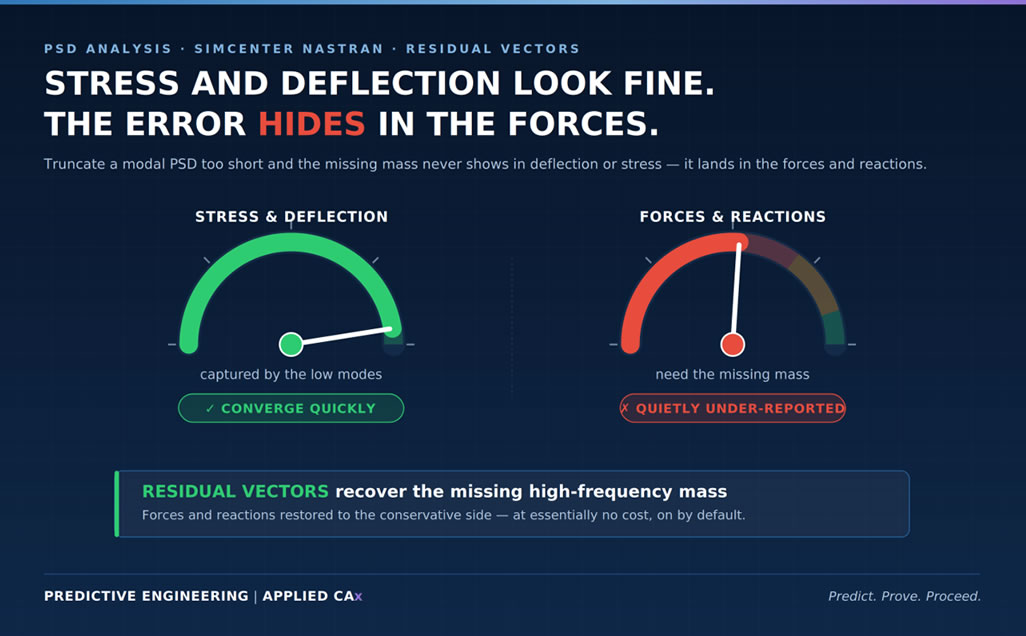
A random-vibration (PSD) analysis is only as honest as the modes behind it. We build the response as a sum of normal modes and lean on a familiar rule of thumb — capture enough of the structure’s mass and you’re safe. But when the retained modes fall short, the missing mass doesn’t disappear; it turns into error. And here’s the part that catches good engineers: that error doesn’t surface where you’re looking. Deflections settle out with only a few modes, and even peak stress can read as fully converged — while the bolt forces and reaction loads, the very quantities your fasteners and joints are sized against, come back quietly low, on the unconservative side.
Residual Vectors are the cure. They capture the high-frequency, quasi-static response the truncated modes leave behind — the “missing mass” — and fold it back into the solution, restoring the forces and reactions to the conservative side at almost no computational cost. Because they’re on by default in Simcenter Nastran, they’re also easy to take for granted. Knowing what they actually do — and the one rule that governs them: they recover only the response above your loading’s energetic band, never a resonance you skipped inside it — is the difference between trusting a fast PSD result and being quietly misled by one.
For the full treatment — the theory, a worked example, the figures, and the model to run yourself — see the technical note: Life and Times of Residual Vectors for PSD Analysis (PDF).